
PATJ, a tight junction-associated PDZ protein, is a novel degradation target of high-risk human papillomavirus E6 and the alternatively spliced isoform 18 E6.

The E6 protein from high-risk human papillomavirus varieties interacts with and degrades a number of PDZ domain-containing proteins that localize to adherens junctions or tight junctions in polarized epithelial cells. We have recognized the tight junction-associated multi-PDZ protein PATJ (PALS1-associated TJ protein) as a novel binding associate and degradation target of high-risk varieties 16 and 18 E6.

PATJ capabilities in the meeting of the evolutionarily conserved CRB-PALS1-PATJ and Par6-aPKC-Par3 complexes and is crucial for the formation of tight junctions in polarized cells.

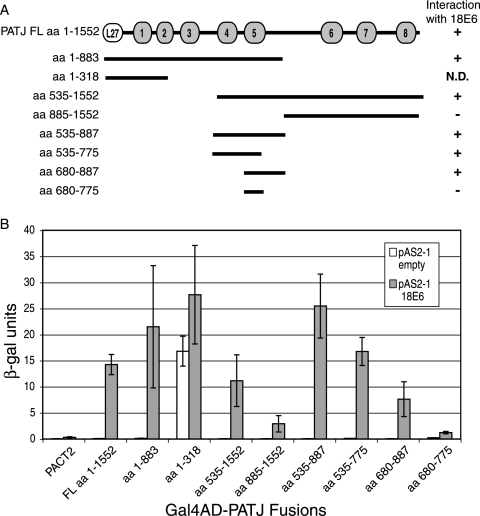
The means of sort 18 E6 full-length to bind to, and the subsequent degradation of, PATJ is depending on its C-terminal PDZ binding motif. We display that the spliced 18 E6* protein, which lacks a C-terminal PDZ binding motif, associates with and degrades PATJ independently of full-length 18 E6.

Thus, PATJ is the first binding associate that is degraded in response to each isoforms of 18 E6. The means of E6 to make the most of a non-E6AP ubiquitin ligase for the degradation of a number of PDZ binding companions has been recommended. We additionally display that 18 E6-mediated degradation of PATJ is not inhibited in cells the place E6AP is silenced by shRNA. This means that the E6-E6AP complicated is not required for the degradation of this protein target.

PATJ, a tight junction-associated PDZ protein, is a novel degradation target of high-risk human papillomavirus E6 and the alternatively spliced isoform 18 E6.

Evolutionary dynamics of variant genomes of human papillomavirus varieties 18, 45, and 97.

Human papillomavirus sort 18 (HPV18) and HPV45 account for about 20% of all cervix cancers. We present that HPV18, HPV45, and the just lately found HPV97 comprise a clade sharing a most up-to-date widespread ancestor inside HPV alpha7 species.

Variant lineages of these HPV varieties had been labeled by sequence evaluation of the upstream regulatory area/E6 area amongst cervical samples from a population-based research in Costa Rica, and 27 consultant genomes from every main variant lineage had been sequenced.

Nucleotide variation inside HPV18 and HPV45 was 3.82% and 2.39%, respectively, and amino acid variation was 4.73% and 2.87%, respectively. Only 18 nucleotide variations, of which 10 had been nonsynonymous, had been recognized amongst three HPV97 genomes. Full-genome comparisons revealed maximal variety between HPV18 African and non-African variants (2.6% dissimilarity), whereas HPV18 Asian-American [E1 (AA)] and European (E2) variants had been intently associated (lower than 0.5% dissimilarity); HPV45 genomes had a maximal distinction of 1.6% nucleotides.

Using a Bayesian Markov chain Monte Carlo (MCMC) methodology, the divergence instances of HPV18, -45, and -97 from their most up-to-date widespread ancestors indicated that HPV18 diverged roughly 7.7 million years (Myr) in the past, whereas HPV45 and HPV97 cut up off round 5.7 Myr in the past, in a interval encompassing the divergence of the nice ape species. Variants inside the HPV18/45/97 lineages had been estimated to have diverged from their widespread ancestors in the genus Homo inside the final 1 Myr (<0.7 Myr).

To examine the molecular foundation of HPV18, HPV45, and HPV97 evolution, regression fashions of codon substitution had been used to determine lineages and amino acid websites beneath selective strain. The E5 open studying body (ORF) of HPV18 and the E4 ORFs of HPV18, HPV45, and HPV18/45/97 had nonsynonymous/synonymous substitution charge ratios (d(N)/d(S)) over 1 indicative of optimistic Darwinian choice.

The L1 ORF of HPV18 genomes had an elevated proportion of nonsynonymous substitutions (4.93%; common d(N)/d(S) ratio [M3] = 0.3356) in comparison with HPV45 (1.86%; M3 = 0.1268) and HPV16 (2.26%; M3 = 0.1330) L1 ORFs.

In distinction, HPV18 and HPV16 genomes had comparable amino acid substitution charges inside the E1 ORF (2.89% and 3.24%, respectively), whereas HPV45 E1 was extremely conserved (amino acid substitution charge was 0.77%).

These information present an evolutionary historical past of this medically vital clade of HPVs and determine an surprising divergence of the L1 gene of HPV18 which will have scientific implications for the long-term use of an L1-virus-like particle-based prophylactic vaccine.

High sustained efficacy of a prophylactic quadrivalent human papillomavirus types 6/11/16/18 L1 virus-like particle vaccine through 5 years of follow-up.

Human papillomavirus (HPV) causes cervical, vulvar, and vaginal cancers, precancerous dysplasia, and genital warts. We report knowledge for the longest efficacy analysis up to now of a prophylactic HPV vaccine. In complete, 552 ladies (16-23 years) have been enrolled in a randomised, placebo-controlled research of a quadrivalent HPV 6/11/16/18 L1 virus-like-particle vaccine with vaccination at months 0, 2, and 6. At common intervals through 3 years, topics underwent gynaecologic examination, cervicovaginal sampling for HPV DNA, serum anti-HPV testing, and Pap testing, with follow-up biopsy as indicated. A subset of 241 topics underwent two additional years of follow-up. At 5 years submit enrollment, the mixed incidence of HPV 6/11/16/18-related persistent an infection or illness was diminished in vaccine-recipients by 96% (two circumstances vaccine versus 46 placebo).

There have been no circumstances of HPV 6/11/16/18-related precancerous cervical dysplasia or genital warts in vaccine recipients, and 6 circumstances in placebo recipients (efficacy = 100%; 95% CI:12-100%). Through 5 years, vaccine-induced anti-HPV geometric imply titres remained at or above these following pure an infection.

In conclusion, a prophylactic quadrivalent HPV vaccine was efficient through 5 years for prevention of persistent an infection and illness attributable to HPV 6/11/16/18. This length helps vaccination of adolescents and younger adults, which is anticipated to tremendously scale back the burden of cervical and genital cancers, precancerous dysplasia, and genital warts.

High sustained efficacy of a prophylactic quadrivalent human papillomavirus types 6/11/16/18 L1 virus-like particle vaccine through 5 years of follow-up.

Different human cervical carcinoma cell traces present comparable transcription patterns of human papillomavirus sort 18 early genes.

Transcription of human papillomavirus sort 18 (HPV18) DNA within the human cervical carcinoma cell traces HeLa, C4-1 and SW756 was studied by nucleotide sequence evaluation of HPV18-positive cDNA clones remoted from a HeLa, C4-1 and SW756 cDNA library, respectively, and the cDNA sequences have been used to foretell the potential encoded proteins.

The cDNA clones from all three cell traces have been discovered to be derived from virus-cell fusion transcripts wherein 3′-terminal host cell sequences (totally different for every cell line) have been spliced to 5′-terminal exon sequences from the HPV18 E6-E7-E1 area. Three totally different types of cDNA clones could be distinguished in response to the splicing patterns noticed within the 5′ terminal HPV18 sequences. They carry as potential protein-coding areas the HPV18 particular open studying frames E6 and E6* (generated by splicing and an identical with E6 as much as the E6* splice junction), E7 and E1 (solely in HeLa).

Translation of particular mobile genes from the chimeric viral-cellular transcripts appears to be unlikely. The mapping of the 5′-ends of the virus-cell fusion transcripts signifies that transcription is initiated at a viral promoter. The comparable patterns of HPV18 transcription within the three totally different cervical carcinoma cell traces counsel a purposeful function of HPV18 early genes for the malignant phenotype of these cells.

A cellular protein mediates association of p53 with the E6 oncoprotein of human papillomavirus types 16 or 18.

The E6 protein of human papillomavirus types 16 and 18 (HPV-16 and HPV-18) can stably affiliate with the p53 protein in vitro. In the presence of rabbit reticulocyte lysate, this association results in the particular degradation of p53 via the ubiquitin-dependent proteolysis system.

We have examined the E6-p53 advanced in additional element and have discovered that association of E6 with p53 is mediated by an extra cellular issue. This issue is current in rabbit reticulocyte lysate, main human keratinocytes and in every of 5 human cell strains examined.

The issue is designated E6-AP, for E6-associated protein, based mostly on the statement that the E6 proteins of HPV-16 and 18 can kind a steady advanced with the think about the absence of p53, whereas p53 association with the issue will be detected solely in the presence of E6. Gel filtration and coprecipitation experiments point out that E6-AP is a monomeric protein of roughly 100 kDa.

A cellular protein mediates association of p53 with the E6 oncoprotein of human papillomavirus types 16 or 18.

The elevated 10-year threat of cervical precancer and most cancers in girls with human papillomavirus (HPV) kind 16 or 18 and the doable utility of type-specific HPV testing in medical follow.

BACKGROUNDHuman papillomavirus (HPV) types 16 and 18 trigger 60%-70% of cervical most cancers worldwide, and different HPV types trigger nearly all remaining circumstances. Pooled HPV testing for 13 oncogenic types, together with HPV16 and 18, is at the moment utilized in medical follow for triage of equivocal cytology and, in conjunction with Pap checks, is an choice for normal screening amongst girls 30 years of age and older.

It isn’t clear to what extent particular person identification of HPV16 or HPV18 as an adjunct to pooled oncogenic HPV testing may successfully establish girls at notably excessive threat of cervical most cancers or its instant precursor, cervical intraepithelial neoplasia 3 (CIN3).

METHODSFrom April 1, 1989, to November 2, 1990, a complete of 20 810 girls in the Kaiser Permanente well being plan in Portland, OR, enrolled in a cohort examine of HPV and cervical neoplasia. Women have been examined for 13 oncogenic HPV types by Hybrid Capture 2 (HC2), and people girls with a optimistic HC2 take a look at have been examined for HPV16 and 18.

Enrollment Pap smear interpretation and HPV take a look at outcomes have been linked to histologically confirmed CIN3 and cervical most cancers >> or = CIN3) occurring throughout 10 years of cytologic follow-up. We calculated cumulative incidence charges with 95% confidence intervals for every interval as much as 122 months utilizing Kaplan-Meier strategies.

RESULTSThe 10-year cumulative incidence charges of>> or = CIN3 have been 17.2% (95% confidence interval [CI] = 11.5% to 22.9%) amongst HPV16+ girls and 13.6% (95% CI = 3.6% to 23.7%) amongst HPV18+ (HPV16-) girls, however solely 3.0% (95% CI = 1.9% to 4.2%) amongst HC2+ girls destructive for HPV16 or HPV18. The 10-year cumulative incidence amongst HC2- girls was 0.8% (95% CI = 0.6% to 1.1%).

A subanalysis amongst girls 30 years of age and older with regular cytology at enrollment strengthened the noticed threat variations.CONCLUSIONSHPV screening that distinguishes HPV16 and HPV18 from different oncogenic HPV types might establish girls at the biggest threat of>> or = CIN3 and will allow much less aggressive administration of different girls with oncogenic HPV infections.